
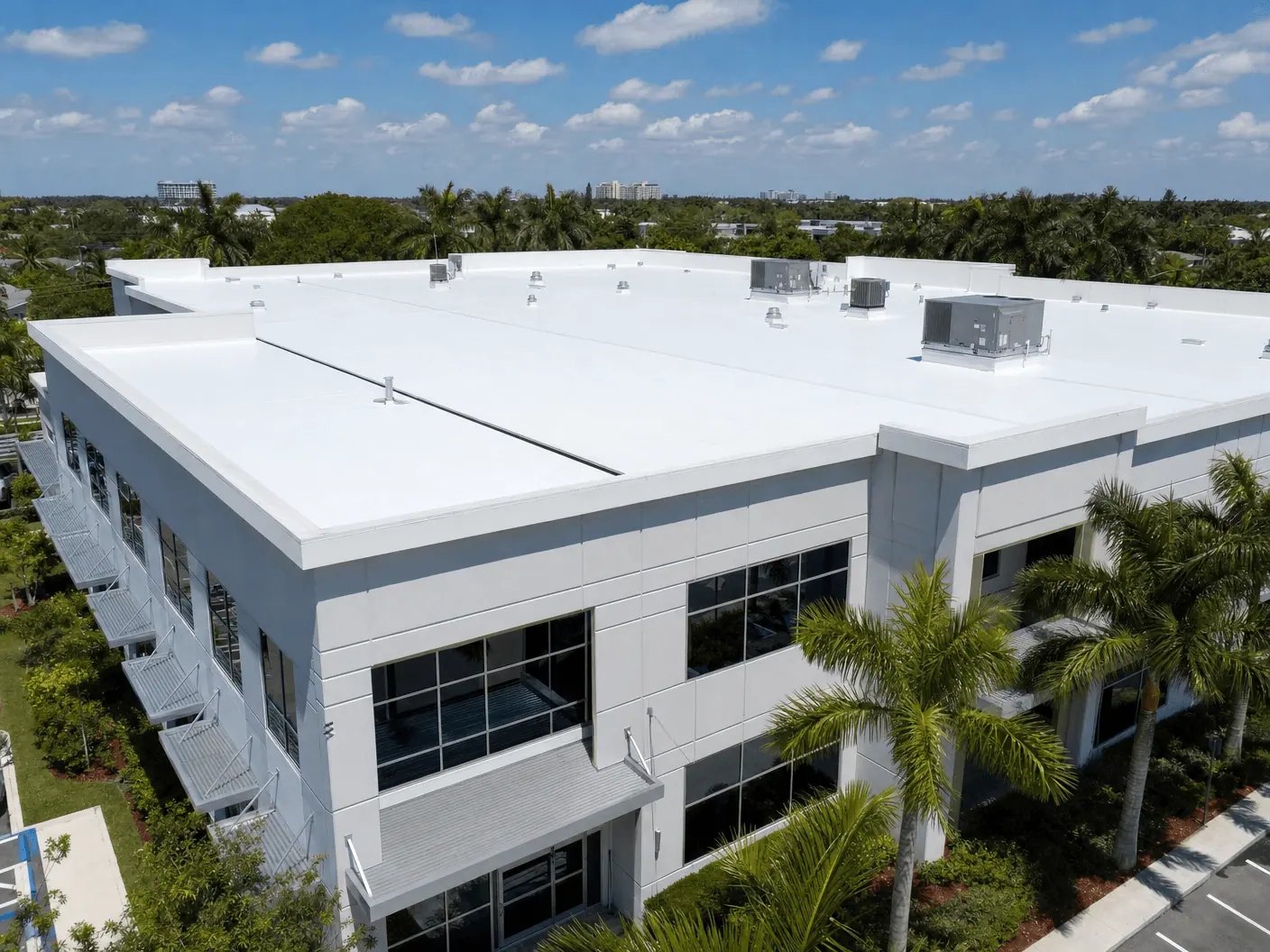
The Gate City Bank corporate headquarters on 13th Avenue South in Fargo, and the Sanford Health System administrative campus that anchors the Fargo-Moorhead healthcare economy, define the Class A and institutional office roofing market in a city where the winter operating environment makes building envelope performance a matter of occupant safety, not merely tenant comfort. Fargo's office buildings face a roofing environment defined by minus-twenty Fahrenheit temperatures sustained for days, ground snow loads of forty pounds per square foot, spring melt flooding from the Red River, and the summer hailstorms that make Douglas County one of the most active hail markets in North America.
Occupied building protocols for Fargo office re-roofing are constrained by the severe limits that North Dakota's climate places on the outdoor construction season. The practical membrane-installation window in Fargo is May 15 through October 1, and every re-roofing project at Sanford Health, Gate City Bank, or similar Class A properties must be completed within that window unless the contractor deploys heated tent systems for extended work. Scheduling constraints within the occupied building — avoiding construction noise during core business hours, phasing work around conference center and meeting room schedules — must be managed within the narrow weather window, which means pre-project planning must be more detailed than in markets with year-round construction seasons.
Green roof systems are not practical for most Fargo office buildings. The combination of forty-pound ground snow loads, the dead load of a saturated growing medium, and the freeze-thaw engineering requirements that govern a system exposed to minus-twenty temperatures creates a structural loading and maintenance challenge that exceeds the capacity of most mid-century Fargo office building frames. Extensive lightweight green roof systems with minimal growing medium depth may be feasible on new construction designed for the additional load, but re-roofing an existing Fargo office building with a green roof requires a structural analysis that almost always reveals the need for supplemental framing before the green roof assembly can be supported.
HVAC coordination at Fargo Class A office buildings is dictated by the seven-month heating season that runs from October through April. Rooftop RTUs, heat pumps, and air handlers at Sanford Health's administrative campus and Gate City Bank's headquarters cannot be offline for more than a few hours during the heating season without creating occupant comfort emergencies. The re-roofing project schedule must be designed around a HVAC matrix showing which units can be safely offline, in what sequence, and for what maximum duration, based on the building's thermal mass and the expected outside temperature during the planned outage window. HVAC rental unit procurement should be budgeted as a contingency for any phase where the planned outage duration may be exceeded.
North Dakota's commercial energy code, which adopts the IECC's Climate Zone 7 provisions for the Fargo area, mandates R-35 minimum above-deck insulation for new commercial construction — among the highest requirements in the continental United States. Re-roofing projects that trigger full code compliance require significant insulation upgrades on older buildings. The extraordinary heating cost reduction that R-35 insulation achieves in Fargo's Climate Zone 7 produces a payback period of five to seven years on most Class A office buildings, and the Otter Tail Power Company and Cass County Electric cooperative efficiency programs offer rebates that shorten that payback. Polyiso's cold-temperature performance loss must be addressed with a cold-temperature-rated formulation to maintain the effective R-value through Fargo's January cold snaps.
Lease obligations at Fargo Class A office buildings are influenced by the Fargo commercial insurance market's heightened awareness of hail damage, which is the leading cause of commercial roofing claims in North Dakota. Major Fargo tenants like Sanford Health and Gate City Bank negotiate lease provisions requiring that the building's roofing system carry documented hail resistance ratings, and several North Dakota commercial property insurers now require FM Approval 1-90 or higher impact resistance documentation as a condition of issuing or renewing commercial roofing coverage. A re-roofing project that upgrades the membrane to an FM hail-rated assembly simultaneously satisfies both lease obligations and insurance requirements.
Cool membrane selection for Fargo office buildings involves the unique calculus of a Climate Zone 7 heating-dominated environment. The maximum-SRI white TPO membrane that is standard practice in warmer markets is actually counterproductive in Fargo, where the building's roof is a meaningful contributor to solar heat gain during the October through April heating season. Most Fargo building engineers specify a gray or medium-reflectance cap sheet for office building re-roofing, accepting lower summer cooling benefit to retain the solar gain that reduces heating load through the long North Dakota winter. This is one of the few markets in the United States where specifying a white reflective membrane may actually increase annual energy costs rather than reduce them.
Snow removal from Fargo office building roofs is a structural safety issue that becomes relevant during heavy snowfall events. The design snow load for Fargo commercial buildings allows for accumulation up to the design level without emergency action, but event accumulations exceeding the design level — which occur during years with multiple major snowfall events — create structural overload risk. Gate City Bank's headquarters and similar Class A Fargo buildings maintain contracts with snow removal contractors for emergency roof snow removal when accumulation exceeds a trigger level established in the building's structural snow management plan. Any re-roofing project should evaluate whether the new assembly's weight, combined with maximum design snow load, leaves adequate margin under the structural capacity of the existing framing.
Selecting a roofing contractor for a Fargo Class A office project requires verifying their North Dakota contractor license, their cold-weather installation experience, and their references from comparable Fargo-market office projects. The short construction season and the stringent climate requirements make contractor experience in the Fargo market a critical qualification criterion. A contractor from a warmer climate who enters the Fargo market for a single large project will encounter cold-weather installation challenges that affect quality, schedule, and warranty compliance. Verify that the proposed membrane manufacturer's warranty explicitly covers the installation conditions at Fargo's latitude without temperature-based exclusions before accepting any warranty document.
- What insulation R-value is required for office re-roofing in Fargo?
- North Dakota's IECC Climate Zone 7 provisions require R-35 minimum above-deck insulation for new commercial construction, among the highest requirements in the continental US. Older Fargo office buildings re-roofed to trigger code compliance must be upgraded accordingly. Specify cold-temperature-rated polyiso formulations to maintain effective R-value at minus-twenty Fahrenheit.
- Should a white reflective membrane be specified for a Fargo office building?
- Not necessarily. Fargo's seven-month heating season makes the roof a meaningful solar heat gain contributor during winter. Medium-reflectance gray membranes at SRI 40 to 60 often achieve better annual energy balance than maximum-SRI white membranes, which eliminate winter solar gain benefit. Consult an energy model for the specific building before specifying maximum SRI.
- Are green roofs practical for Fargo office buildings?
- Not for most existing buildings. The combined structural loading of a saturated growing medium plus North Dakota's forty-pound ground snow load typically exceeds the capacity of mid-century office building frames without supplemental strengthening. Green roofs are feasible only on new construction specifically designed for the additional load.
- What hail resistance documentation do Fargo office tenants and insurers require?
- Major Fargo commercial tenants and several North Dakota property insurers require FM Approval 1-90 or higher impact resistance ratings on commercial roofing assemblies. A re-roofing project that upgrades to an FM hail-rated membrane simultaneously satisfies lease covenant obligations and insurance documentation requirements.
- What is the office re-roofing construction season in Fargo?
- May 15 through October 1 is the practical membrane-installation window. All re-roofing must be planned to complete within this window unless the contractor deploys heated tent systems. Pre-project planning must be more detailed than in milder climates to integrate occupied-building scheduling constraints with the narrow weather window.
Questions Building Owners Ask
What usually changes the price for acrylic and silicone roof coatings?
For acrylic and silicone roof coatings, access, wet insulation, deck repair, edge metal, drains, temporary protection, after-hours work, and occupied-building staging change the number faster than the roof label. We verify those acrylic and silicone roof coatings conditions around Casselton before treating a square-foot price as reliable.
Can acrylic and silicone roof coatings be handled while the building is occupied?
Often, but the acrylic and silicone roof coatings sequence has to be planned. We review entrances, loading docks, patient or tenant areas, roof access, odor sensitivity, and weather windows near Veterans Boulevard Corridor before recommending daytime, phased, or after-hours work.
How do we know if acrylic and silicone roof coatings should be repair, coating, recover, or replacement?
We look at acrylic and silicone roof coatings through wet insulation, deck condition, attachment, slope, seam condition, drain performance, and edge-metal risk. If the roof around June normal precipitation of 4.29 inches is dry and stable for acrylic and silicone roof coatings, preservation options stay on the table. If moisture or deck damage is spreading through acrylic and silicone roof coatings, replacement planning becomes more defensible.
What documentation do we get after a acrylic and silicone roof coatings inspection?
Typical acrylic and silicone roof coatings documentation includes roof-area notes, photo locations, leak or damage observations, priority levels, repair limits, access constraints, and budget categories. On storm work tied to acrylic and silicone roof coatings, we provide contractor-side roof evidence without promising insurance outcomes.
How quickly can you look at acrylic and silicone roof coatings after a leak or storm?
Timing for acrylic and silicone roof coatings depends on weather, crew load, access, and whether interior water is active. We triage emergency conditions first, especially when water is entering occupied space near healthcare campus roofs, and then separate temporary dry-in from permanent scope.