
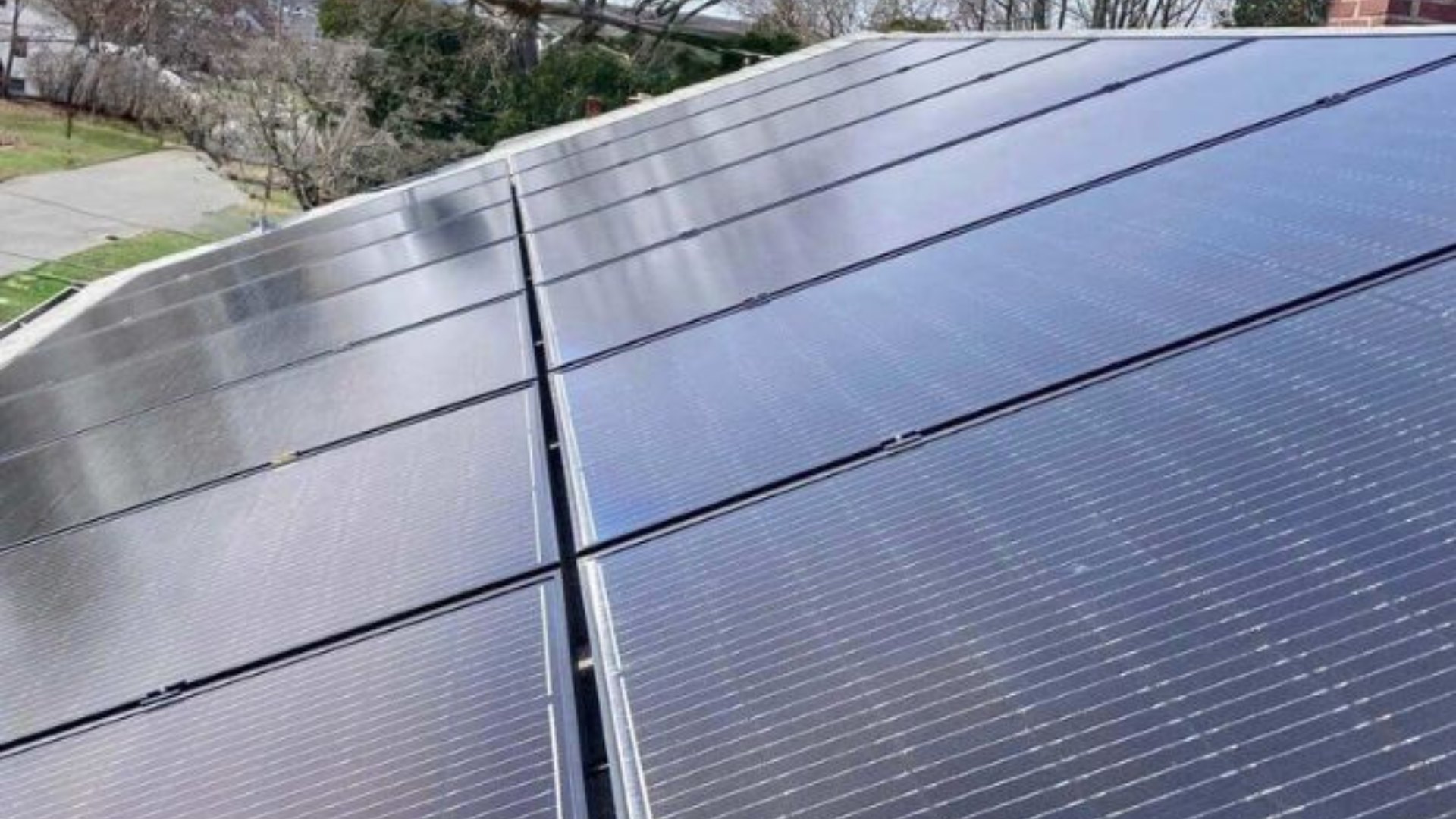
The Roof Under a Solar Array Is the Part Nobody Budgets For
A solar quote almost never mentions the roof. It talks about panels, inverters, kilowatts, and payback years. But the array sits on a membrane, bolts or weights down onto it, and stays there for two to three decades. We get called by Fargo building owners when that gap finally surfaces, usually one of two ways: either a leak shows up under a six-year-old array and nobody can tell whose responsibility it is, or a roof needs replacing and the owner discovers the reroof now costs double because the entire PV system has to come off first. We are roofers. Our part of a solar project is making sure the roof is ready to carry that array for its full life, so neither of those calls ever has to happen.
There is genuine reason to look at rooftop solar on commercial buildings here. Cass County has been among North Dakota's fastest-growing commercial areas, the federal investment tax credit still rewards on-site generation, and Fargo's building stock includes exactly the kind of broad, unshaded low-slope roofs PV wants: distribution and logistics buildings along the I-94 corridor through West Fargo, big-box and retail roofs in the 45th Street and West Acres trade area, and the warehousing tied to the Red River Valley grain and ag-equipment economy. The opportunity is real. The roof underneath it still has to earn its keep first.
Sequence Decides the Economics
The most expensive mistake in commercial solar is installing it on a roof that is too old to keep it. So before anything else, we core the roof, scan it for trapped moisture, check the deck and the structure, and give you a remaining-service-life number you can plan around.
That number sorts every project into one of three paths. If the membrane has roughly fifteen or more years left, mounting solar on the existing roof is sound. If it is somewhere in the middle, pairing solar with a reroof done in the same mobilization usually makes sense. If the roof has seven years or less, you reroof first, period. Here is why that last case is not negotiable: when an aging roof under an array finally fails, every module, rail, and ballast block has to be detached and stored, the membrane is torn off and rebuilt, and then the whole array goes back up. That detach-and-reset cycle routinely adds tens of thousands of dollars to a reroof, and on a large warehouse it climbs into six figures. Replacing a tired roof now, while the deck is open and accessible, is almost always the cheaper path.
Two Ways to Mount, Two Different Roofing Problems
Every low-slope solar array is held down one of two ways, and each creates a distinct challenge for the roof.
Ballasted Racking and the Snow Question
Ballasted systems hold the array with weighted pavers or concrete blocks and, done well, touch the membrane only through protective slip sheets. Most Fargo flat roofs lean this way because it avoids drilling the roof full of holes. The trade is weight, and weight is the live issue in this climate. Fargo carries a heavy ground snow load, and a roof already supporting drifted snow through most of the winter has limited reserve capacity left for ballast. We will not approve a ballasted layout until a structural review confirms the combined snow-plus-ballast load stays inside the building's design capacity. On older buildings that check frequently changes the plan, and we would rather find that out on paper than after the panels are up.
Penetration-Anchored Racking and the Leak Question
Penetration-anchored systems bolt racking feet through the membrane into the structure. They make the weight problem disappear and replace it with dozens or hundreds of holes in your roof. Every one of those is a future leak unless it is flashed like a roofer flashes a penetration: a proper flashed base welded or sealed into the membrane system, not a bead of caulk around a lag bolt. On a mechanically attached single-ply this is routine work when the roofing contractor details it. It becomes a chronic-leak roof when a solar crew improvises the flashing to keep their install moving. We would rather own those penetrations from the start.
Membrane Choice, Reflectivity, and the Conduit Everyone Forgets
Not every membrane belongs beneath an array. For commercial solar in Fargo we generally specify a white reflective single-ply, TPO or PVC at 60-mil, mechanically attached. The white surface keeps the roof and the underside of the modules cooler, which helps panel output across our long, bright summer days, and the single-ply gives the racking a clean, uniform base. Where the snow-plus-ballast math is tight, a fully adhered membrane can let the design drop the ballast requirement entirely.
Conduit is the detail that quietly causes leaks years later. The wiring run from the array to the building's electrical service crosses the roof and punches through the membrane, often at several points. Conduit laid flat and screwed straight to the membrane will abrade and wear a hole through the sheet over time, and a conduit penetration capped with a generic boot instead of a proper through-roof detail becomes a slow recurring leak. We map the conduit route and every penetration with the solar electrician before anything is pulled, then flash those penetrations ourselves so the wire goes through holes that were made to be there.
Making Two Warranties Agree
A solar-on-roof project carries two warranties that have to be reconciled: the membrane manufacturer's and the PV system's. Most major single-ply manufacturers will keep a roof warranty in force under an array, but only on their terms. Approved ballast pads or flashed attachments. Approved walkway protection on every maintenance path the solar crews will use. And a pre-installation review by the manufacturer's representative before the array goes up. We arrange that review at the front of the job so your roof warranty survives the install instead of getting quietly voided the day the modules land. We also lock the build sequence in writing, membrane down and inspected, then penetrations flashed, then racking and panels, so both warranties can be registered cleanly.
How We Work Alongside Your Solar Installer
We do not sell, size, or design PV systems, and we are not angling to. Our scope is the surface that system lands on: confirming the roof is sound enough to carry it, detailing the attachments and conduit so they never leak, and protecting the warranties on both sides. We will sit down with whichever solar EPC you choose for a pre-construction meeting, agree on the mounting method, the conduit plan, and the flashing details, and put the installation order in writing before anyone mobilizes. A strong solar array on the wrong roof is still a poor investment. Keeping you out of that situation is the whole reason to bring a roofer into the conversation before the solar contract is signed. Call us at 701-987-7206 and we will walk your roof first.